Water seepage in Singapore rarely begins as a dramatic flood. More often, it appears as a damp patch that refuses to dry, paint that bubbles again after repainting, a ceiling stain that darkens after rain or a musty smell in a room that otherwise looks normal.
These symptoms matter because the place where moisture becomes visible is not always where the water entered the building.
Water can travel through concrete slabs, screed, cracks, joints, roof surfaces, wet-area membranes, pipes and concealed cavities before appearing somewhere else. A stain on an internal wall may therefore originate from an exterior crack, a bathroom on the other side, a roof detail above or a concealed pipe.
Effective water seepage repair should therefore follow a simple principle:
identify the source → understand the water path → choose the repair method → verify that the seepage has stopped → repair the damaged finish.
Allstar Waterproofing & Services provides water seepage and leakage repair for residential, commercial and industrial properties in Singapore. Its current services include ceiling and wall leakage repair, wet-area waterproofing, roof repair and waterproofing, concrete repair and rope-access work for difficult exterior locations. The company’s published process begins with inspection before a repair method is recommended.
This guide explains how to identify likely water-seepage sources, when to call a plumber or waterproofing contractor, how common repair methods work, what HDB and condominium owners should know about inter-floor seepage, what repairs may cost and how to determine whether the problem has actually been solved.
What Should You Do When You First Notice Water Seepage?
Do not repaint the area immediately.
Start by documenting where the dampness appears and when it becomes worse.
A ceiling stain that darkens shortly after heavy rain gives a different diagnostic clue from moisture that appears after someone uses the bathroom upstairs.
Likewise, a damp wall that remains wet regardless of weather or wet-area use may justify checking plumbing or another continuous water source.
Photographs are useful because they show whether the affected area is expanding over time. Note whether the problem appears after rain, showering, air-conditioning use or other repeated conditions.
If water is close to electrical fittings, if the ceiling is visibly bulging or if concrete is spalling, the issue deserves prompt attention rather than cosmetic repair.
The first objective is not to decide whether you need PU injection, coating or hacking.
It is to understand where the water is coming from.
What Causes Water Seepage in Singapore Properties?
Water seepage occurs when rainwater, wet-area water or plumbing water finds a pathway through a building element that is no longer keeping moisture where it belongs.
Possible sources include failed bathroom or balcony waterproofing, cracks or honeycombed areas in concrete, deteriorated joints, roof defects, damaged seals, porous exterior surfaces, leaking pipes and drainage problems.
Singapore’s regular rainfall and humid climate mean roofs, façades, balconies and external surfaces are repeatedly exposed to moisture.
Wet areas such as bathrooms and toilets face a different type of repeated exposure because their waterproofing systems regularly hold back water beneath tiled finishes.
This is why two visually similar ceiling stains can require completely different repairs.
One may be caused by a failed waterproofing membrane.
Another may come from a pipe.
A third may appear only when wind-driven rain reaches an exterior crack.
Where Is the Water Seepage Most Likely Coming From?
The timing and location of the moisture can provide useful clues, although they do not replace inspection.
If seepage appears mainly during or after rain, the investigation should consider the roof, external wall, façade joints, window interfaces, flashing, gutters and drainage.
If the affected area becomes wet after showering, washing or repeated wet-area use, the bathroom, toilet, balcony or another wet-area waterproofing system may be involved.
If dampness appears consistently regardless of weather, plumbing deserves closer consideration, particularly if the affected area is close to water or sanitary pipes.
If water follows a narrow pathway through concrete or appears around a specific crack, joint or honeycombed area, a concrete defect may be involved.
Rust staining, exposed reinforcement or spalling concrete suggests that the issue may extend beyond waterproofing alone and that concrete repair may also be required.
The important principle is that these patterns indicate where to investigate, not automatically which product to use.
Can Water Travel Far From the Actual Leak?
Yes.
Water can move laterally through concrete, screed, joints and concealed spaces before it becomes visible.
A ceiling stain may therefore be some distance from the original water entry point.
This is particularly relevant in bathrooms and balconies where water can move beneath finished tiles through screed before finding a crack or penetration through the slab.
Rain entering through an external façade can similarly follow a concealed route before appearing on an interior wall.
This explains why repeatedly sealing the nearest visible crack or repainting the stained surface can fail.
The repair may temporarily hide the symptom while leaving the original pathway untouched.
What Are the Main Signs of Water Seepage?
Recurring damp patches, water stains, peeling or bubbling paint, musty smells, mould and discolouration are common warning signs.
Ceilings may develop brown or yellow staining, localised deformation or paint that repeatedly blisters after being repaired.
Walls can remain cool or damp to the touch, particularly after rainfall.
Floor finishes or skirting may show deterioration where moisture is moving through adjoining surfaces.
Rust staining and spalling concrete deserve particular attention because moisture may have reached embedded reinforcement.
The pattern matters as much as the appearance.
A stain that repeatedly returns under the same conditions tells you more than a stain that has remained unchanged for years.
What Is the Difference Between Water Seepage and Water Leakage?
The terms are often used interchangeably, but they can describe slightly different situations.
Water leakage commonly suggests water escaping from a specific defect such as a leaking pipe, roof opening or failed joint.
Water seepage often describes slower moisture penetration through porous materials, cracks, membranes or building interfaces.
In practice, the distinction is less important than identifying the actual source.
Both problems require the contractor to understand where water originates, how it travels and what has failed before recommending a repair.
Why Is Source Diagnosis the Most Important Step?
Source diagnosis matters because the wrong repair method can waste money while allowing the original problem to continue.
A localised crack through concrete may be suitable for injection.
A failed bathroom waterproofing system may require treatment to the wet area.
A leaking pipe requires plumbing repair.
A roof flashing failure needs roof work.
An external-wall problem may require crack or joint repair followed by a suitable protective system.
Allstar’s current leakage guidance similarly warns against recommending injection, coatings or hacking as universal solutions before the condition has been properly assessed.
For straightforward situations, Allstar states that a quotation may sometimes be provided during inspection, while more complex proposals may require approximately one to three working days.
The important part is not how quickly a quotation appears.
It is whether the contractor can explain what is causing the seepage and why the proposed method suits that defect.
Should You Call a Plumber or a Waterproofing Contractor?
It depends on what has failed.
A plumber is generally the more appropriate trade when the source is clearly a water pipe, sanitary pipe, plumbing fitting or another plumbing component.
A waterproofing or leakage specialist is more relevant when the problem involves concrete seepage, failed waterproofing membranes, roofs, balconies, façades, external joints or other parts of the building envelope.
Allstar’s current guidance similarly distinguishes plumbing faults from waterproofing and structural water paths rather than treating every damp patch as a waterproofing problem.
When the source is unclear, the best first step is diagnosis.
Calling a plumber because the stain is near a bathroom can waste time if the real problem is the waterproofing membrane.
Calling a waterproofing contractor to coat a surface will not solve a leaking pipe.
The trade should follow the defect.
Which Water Seepage Repair Methods Does Allstar Use?
There is no single repair method for every seepage problem.
Allstar’s published methods include polyurethane injection, Flood Infusion crystallisation treatment, nano-technology coating, waterproofing coatings, wet-area waterproofing, roof waterproofing and concrete repair.
The appropriate method depends on where the water is entering and what material or system has failed.
How Does PU Injection Repair Water Seepage?
Polyurethane injection, commonly called PU injection or grouting, can be used for suitable cracks, joints, voids and honeycombed areas in concrete.
The material is injected under pressure into the affected pathway.
When the polyurethane reacts with moisture, it expands and helps fill pores or cracks through which water is travelling. Allstar currently describes PU injection as one of its main methods for suitable concrete water-seepage problems.
Its main advantage is that a localised water path may sometimes be treated without opening a much larger area.
However, PU injection is not a universal waterproofing solution.
It does not repair a leaking pipe.
It does not correct defective roof flashing.
It also does not automatically restore an extensively failed bathroom waterproofing system.
Before agreeing to injection, the owner should understand exactly which water pathway is being injected and why the contractor expects the method to work.
What Is Flood Infusion or Crystallisation Treatment?
Flood Infusion is a crystallisation-based treatment used by Allstar for suitable concrete and wet-area seepage conditions.
The company describes the method as allowing crystalline compounds to penetrate pores and capillaries within concrete and form a barrier against water penetration.
In suitable situations, this type of approach can reduce the amount of hacking required.
That does not mean all seepage should be treated without hacking.
If the underlying screed, tiles, membrane or substrate has deteriorated extensively, a broader repair may still be required.
The advantage of a non-hacking solution depends entirely on whether it matches the actual defect.
When Are Nano and Waterproofing Coatings Used?
Allstar also uses nano-technology coating and waterproofing coatings for selected surfaces.
Its nano coating is described as a liquid-applied system that penetrates pores or capillaries and gives the treated surface greater water repellency while allowing the substrate to remain breathable.
Waterproofing coatings can also form part of roof and external-wall treatment after cracks, joints and surface defects have been appropriately prepared.
Coatings work best when the water-entry mechanism is compatible with a surface treatment.
Applying a coating over a surface without correcting the underlying defect can simply move the problem or delay its return.
Can Water Seepage Be Repaired Without Hacking?
Yes, in some situations.
PU injection, crystallisation-based treatments and selected coating systems can reduce demolition where the defect is localised and the underlying substrate remains suitable.
Allstar also provides both hacking and non-hacking approaches for selected wet-area waterproofing problems.
However, “no hacking” should not be treated as the goal before diagnosis.
Hacking may still be necessary where a failed membrane, damaged screed, de-bonded finishes or another concealed layer needs to be accessed and replaced.
A contractor who promises that every leak can be solved without hacking before investigating the source should be asked to explain how that conclusion was reached.
How Are Wet-Area and Ceiling Seepage Connected?
Bathrooms, toilets, kitchens and balconies can cause inter-floor seepage because water is repeatedly used above a waterproofing system hidden beneath finished surfaces.
Weak points can develop around structural joints, pipe penetrations, floor traps, cracks, screed and waterproofing interfaces.
When water passes through the wet-area system, it may travel through the screed or slab before appearing on the ceiling below.
This is why the correct sequence is generally to address the source first and repair the damaged ceiling finish afterwards.
Painting the ceiling below may make it look better temporarily, but it does not restore the waterproofing above.
Who Is Responsible for Ceiling Seepage in an HDB Flat?
For an HDB ceiling leak between flats, the upper and lower neighbours should first establish the source and arrange the repair.
HDB explains that inter-floor ceiling leaks commonly occur when water from the unit above passes through the floor slab, often because the waterproof membrane or screed has deteriorated.
Where repair to the floor or ceiling slab is required, HDB states that the upper- and lower-floor owners should arrange the repair together and split the cost.
The situation changes if the source is common property.
For example, a leak affecting a top-floor flat that originates from the block’s roof is a Town Council maintenance issue. HDB also states that where repair is required to an external wall or rooftop that forms part of common property, the Town Council bears the repair cost.
The important first question is therefore not simply:
“Who pays?”
It is:
“Where is the leak actually coming from?”
The source determines which parties should be involved.
Who Is Responsible for Water Seepage in a Condominium?
For strata-titled condominiums, BCA’s Strata Management Guide explains that where there is evidence of inter-floor water seepage on the interior ceiling of a unit, the defect is generally presumed to be situated in the unit immediately above unless evidence shows otherwise.
The upper- and lower-floor subsidiary proprietors should jointly investigate the cause and determine the required repair.
Where the source is within an individual lot, the relevant subsidiary proprietor is responsible for carrying out repairs.
Where the source comes from common property, BCA states that the Management Corporation should investigate and has a duty to properly maintain and repair the common property.
This means a condominium ceiling leak should not automatically be treated as an argument between neighbours.
The practical sequence is to determine whether the defect originates from the upper unit, the lower unit, or common property and then involve the appropriate party.
BCA’s guidance is practical information rather than individual legal advice, so owners dealing with a disputed or complex case should refer to their MCST and the applicable strata-management process.
How Are Roof and External-Wall Seepage Repaired?
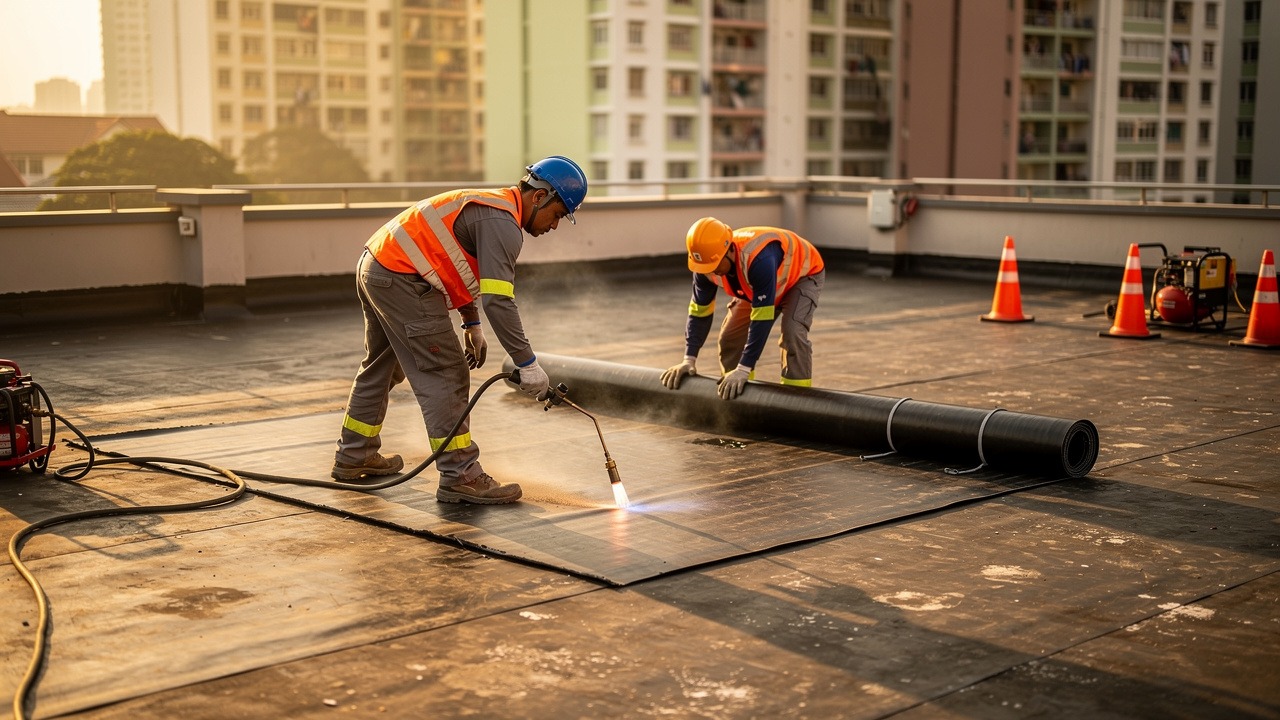
Roof and façade leakage often becomes more obvious during or after rainfall.
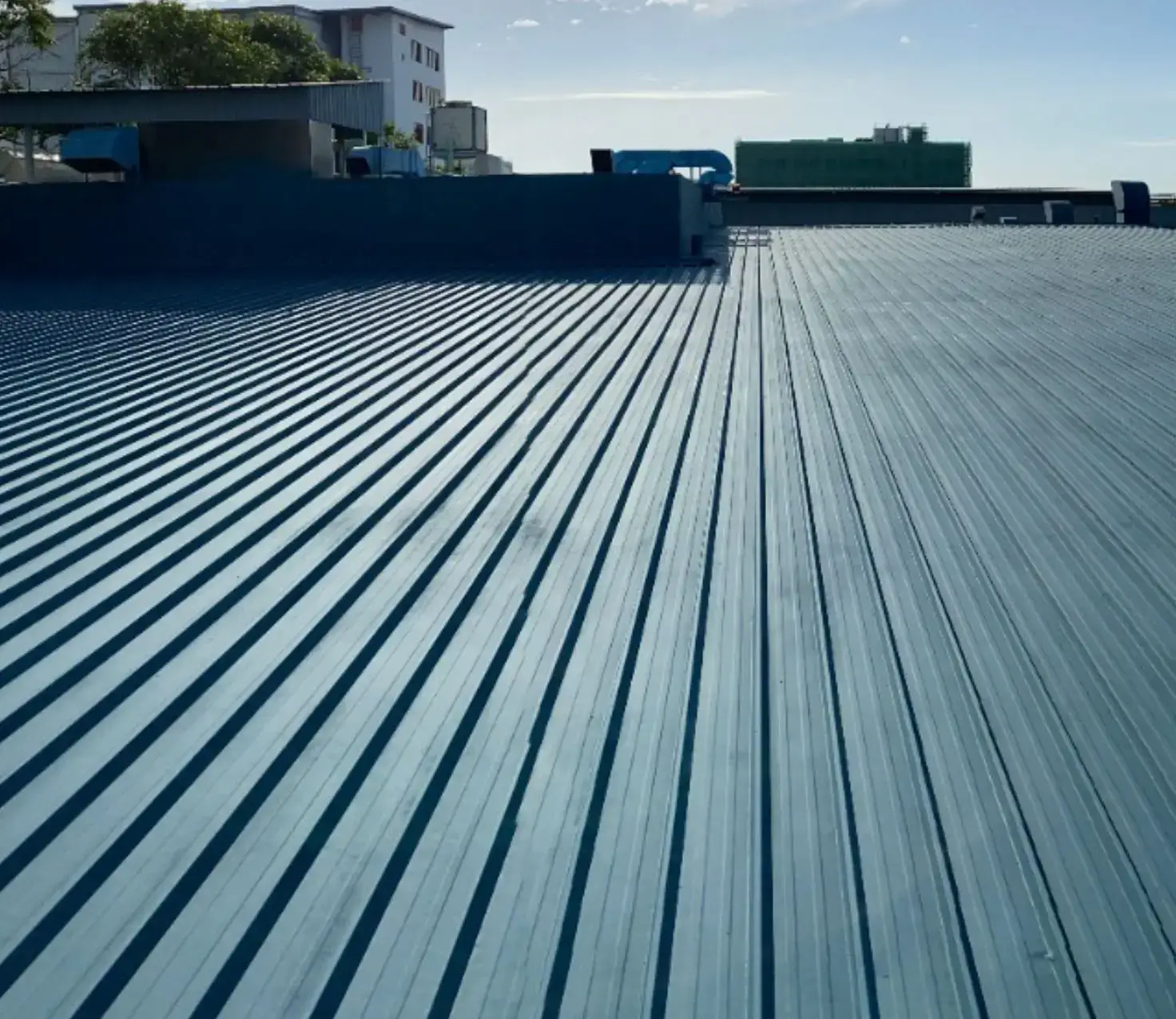
Possible roof defects include deteriorated flashing, open joints, damaged tiles, loose fasteners, hairline cracks, membrane deterioration, oxidation and ponding water.
The repair should address the failed component before relying on a new surface coating.
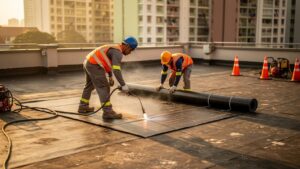
Depending on the project, roof waterproofing may involve liquid-applied or membrane systems after the underlying defect has been prepared.
External-wall seepage may involve cracks, joints, porous surfaces or interfaces around building components.
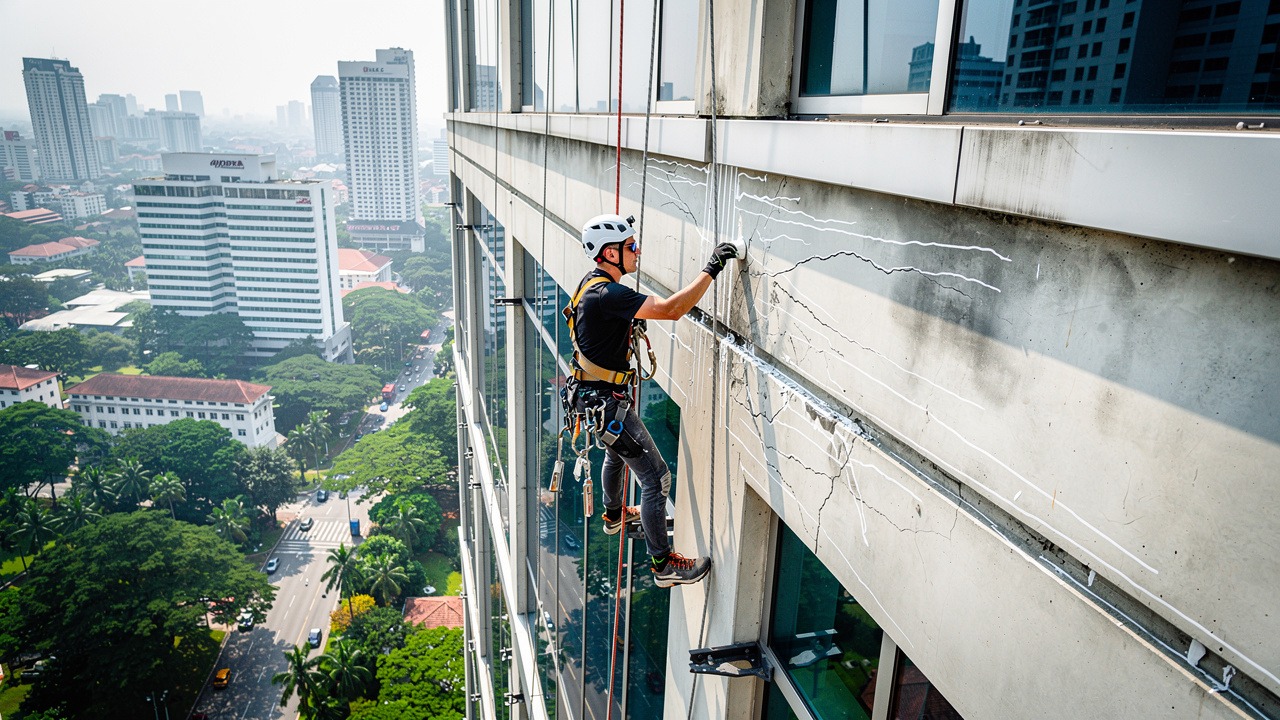
For difficult exterior locations, Allstar also provides rope-access services, allowing high façade areas to be inspected or repaired without relying solely on conventional access equipment.
How Much Does Water Seepage Repair Cost in Singapore?
There is no universal price because “water seepage” describes a symptom, not one standard scope of work.
PU injection, bathroom waterproofing, concrete repair, roof work and façade treatment require different materials, access and preparation.
Allstar currently publishes approximately S800toS1,500 as a planning reference for waterproofing an average bathroom of around four to six square metres. Allstar’s newer guidance makes clear that this is a bathroom-specific planning figure rather than a universal water-leakage price.
Allstar also publishes approximately S5toS20 per square metre as an indicative reference for certain roof-waterproofing applications. That number is roof-specific and should not be applied to PU injection, bathroom waterproofing, façade treatment or concrete repair generally.
A project requiring hacking, tile reinstatement, screed replacement, concrete repair, difficult access or several defects can cost substantially more.
The useful question is therefore not:
“What is the price of water seepage repair?”
It is:
“What has failed, what needs to be repaired and what is included in this quotation?”
What Should a Water Seepage Repair Quotation Include?
A useful quotation should make the repair logic understandable.
It should identify the suspected source, the treatment area and the proposed method.
If injection is recommended, the owner should understand what crack, joint or concrete pathway is being treated.
If waterproofing is proposed, the quotation should clarify which surfaces or layers are included.
Where hacking is required, reinstatement of screed, tiles or finishes should be clearly addressed.
Access work, concrete repair and other additional requirements should also be defined rather than assumed.
Warranty terms matter as well.
Allstar currently states that its repair work is backed by a one-year warranty, with extended warranty options available for discussion. Its current service page also describes its inspection as free and its quotations as no-obligation.
The exact warranty should still be checked for the individual project.
A repaired crack and a new leak from an unrelated source are not automatically the same defect.
The written quotation should therefore identify the covered area, duration and important exclusions.
How Do You Know Whether Water Seepage Repair Worked?
A successful repair should be verified under conditions similar to those that previously triggered the leak.
If the seepage used to appear after rain, the repaired area should remain dry through subsequent relevant rainfall.
If the problem was associated with a wet area, verification may involve observing the area after normal use or performing an appropriate water or ponding test where suitable.
If the repair involved a localised concrete pathway, the previously affected location should remain dry and should not develop fresh staining, bubbling or moisture.
The correct verification method depends on what was repaired.
This is why an immediate dry appearance directly after treatment is not always enough to prove success.
Moisture already trapped in building materials can also take time to dry.
The more useful question is whether new water continues entering under the conditions that previously caused the problem.
Only after that has been established should cosmetic reinstatement such as painting be treated as the final step.
What Should You Do If the Water Seepage Returns?
Document it before repainting.
Take new photographs and compare the location with the original problem.
Note whether the moisture returns under the same conditions as before.
A rain-related leak that reappears after the next heavy storm may indicate that the original pathway remains active.
A new stain in a different position or moisture associated with a different trigger may indicate a separate defect.
Allstar’s current guidance similarly recommends distinguishing between moisture returning through the repaired area and a new leak from another source before assuming that the original waterproofing repair has failed.
Review the original quotation and warranty terms before contacting the contractor so the previous repair area and scope can be compared with the new evidence.
What Experience Does Allstar Publish?
Allstar states that it has more than 20 years of industry experience and has served more than 3,000 residential, commercial and industrial clients.
Its current leakage-repair page also states that it provides free inspections, transparent quotations and a one-year warranty on repair work.
For high-access exterior work, Allstar states that it uses IRATA-certified rope-access personnel.
For property owners, however, credentials should support rather than replace technical reasoning.
The contractor should still be able to explain the source of the seepage, why a particular method is being recommended and how the result will be verified.
How Can You Reduce the Risk of Water Seepage Returning?
Prevention starts by correcting conditions that repeatedly expose weak building areas to water.
Roof gutters and drainage points should remain clear so water does not pond unnecessarily.
Roof flashings, joints, tiles and exposed surfaces should be checked when deterioration becomes visible.
Bathrooms, toilets and balconies should be investigated when dampness begins recurring rather than waiting for significant ceiling damage below.
Plumbing defects should be repaired promptly because waterproofing cannot compensate for a leaking pipe.
Exterior cracks and deteriorated seals should also be addressed before repeated rainfall enlarges the water pathway.
Maintenance is particularly important after a previous leak because the repaired defect does not prevent a different component from failing later.
Frequently Asked Questions About Water Seepage Repair in Singapore
What Should I Do First if I Notice Water Seepage?
Document where and when the moisture appears before repainting or sealing the area. Check whether it is associated with rain, bathroom use or continuous moisture, then arrange an inspection so the likely source can be identified before a repair method is selected.
Can Water Seepage Be Fixed Without Hacking?
Yes, in suitable cases. PU injection, crystallisation treatments and selected coating systems can reduce the need for hacking where the defect and substrate are suitable. Extensive membrane, screed or finish deterioration may still require the area to be opened and rebuilt.
Should I Call a Plumber or Waterproofing Contractor?
Use a plumber when the source is a pipe, sanitary fitting or plumbing system. Waterproofing specialists are more appropriate for membranes, concrete seepage, roofs, façades and other building-envelope defects. If the source is unclear, diagnose it before choosing the trade.
Why Does My Ceiling Leak Only When It Rains?
A leak that appears mainly after rainfall can indicate a roof, external wall, joint, flashing or drainage problem. Water may travel before appearing on the ceiling, so the point of staining is not necessarily the entry point.
Why Does My Ceiling Leak After Someone Showers Upstairs?
If the moisture appears after wet-area use, the investigation should consider the bathroom or toilet waterproofing system, pipe penetrations, joints and plumbing. The trigger helps narrow the diagnosis but does not by itself prove which component has failed.
Who Pays for an HDB Ceiling Leak?
For inter-floor ceiling leakage involving the slabs between two HDB flats, HDB states that the upper- and lower-floor owners should arrange the repair and split the cost. If the source is common property such as a rooftop or external wall, the Town Council may be responsible for the repair.
Who Is Responsible for Water Seepage in a Condominium?
BCA guidance says inter-floor seepage is generally presumed to originate from the unit immediately above unless evidence shows otherwise, and the upper and lower owners should jointly investigate. If the source comes from common property, the Management Corporation is responsible for maintaining and repairing that common property.
How Much Does Water Seepage Repair Cost in Singapore?
There is no universal price. Allstar publishes approximately S800toS1,500 as a planning reference for waterproofing an average four-to-six-square-metre bathroom and approximately S5toS20 per square metre as an indicative reference for certain roof-waterproofing applications. These are service-specific figures rather than general seepage-repair rates.
How Long Does Water Seepage Repair Take?
The timeframe depends on the repair. A local injection can be considerably shorter than hacking and rebuilding a wet-area waterproofing system, repairing a large roof or carrying out concrete and façade work. Preparation, curing, access, weather and reinstatement can all affect completion time.
How Do I Know Whether the Repair Worked?
The repaired area should remain dry when exposed to the conditions that previously caused the seepage. Depending on the source, verification may involve normal wet-area use, an appropriate water test, subsequent rainfall or follow-up observation. The absence of an immediate stain alone is not always enough.
Does Allstar Provide a Warranty?
Allstar currently states that its repair work is backed by a one-year warranty, with extended warranty options available for discussion. The exact repair area, coverage and exclusions should be confirmed in the quotation for the specific project.
Conclusion
Water seepage repair in Singapore is most reliable when the contractor repairs the water pathway, not simply the surface where moisture becomes visible.
A damp ceiling or wall can originate from a wet-area waterproofing failure, concrete crack, plumbing problem, roof defect, façade joint, drainage issue or common-property component.
Because water can travel before appearing, diagnosis needs to come before the repair method.
The practical sequence is:
document the symptom → identify when it occurs → trace the likely source → choose a repair that matches the defect → verify the result → reinstate the finish → monitor for recurrence.
For HDB and condominium properties, identifying the source also helps determine which neighbour, owner, Town Council or MCST should be involved.
Allstar Waterproofing & Services currently provides PU injection, crystallisation treatment, coatings, wet-area waterproofing, roof work, concrete repair and difficult-access exterior work for different types of water-seepage problems.
The strongest repair is therefore not automatically the one involving the newest product, the least hacking or the most extensive work.
It is the one that can clearly answer three questions:
Where is the water entering? Why is this repair suitable? How will we know the water path has been stopped?