
Ceiling Water Leakage Singapore: What to Do Immediately and How to Fix It
Water leaking from a ceiling is one of the clearest signs that water has already travelled beyond its original source.
The stain or drip you see may be directly below a bathroom, but it can also come from a roof defect, balcony, concrete crack, external wall or concealed plumbing problem. In Singapore, the visible ceiling damage is often the end point of the water path rather than the place where the problem began.
If water is actively dripping, deal with the immediate risk first. Move furniture, electronics and valuables away from the affected area, contain dripping water where it is safe to do so and photograph the ceiling before repainting or covering the evidence.
If a clearly identified plumbing pipe or fitting is leaking and the supply can be isolated safely, shutting off that supply can limit further damage.
If water is close to electrical fittings, switches, lights or wiring, avoid touching the wet area or electrical equipment and arrange appropriate professional assistance.
After the immediate situation is controlled, the correct sequence is:
make the area safe → identify when the leak occurs → find the source → repair the cause → verify that the leak has stopped → allow the ceiling to dry → reinstate the finish.
Allstar Waterproofing & Services provides ceiling leakage repair together with water seepage and leakage repair, wet-area waterproofing, roof waterproofing and repair, concrete repair and difficult-access exterior work for residential, commercial and industrial properties in Singapore.
Its current ceiling-leak guidance follows the same diagnosis-first principle: find the source, correct the cause, allow the affected area to dry and only then repair the visible ceiling.
What Should You Do Immediately When Water Is Leaking From the Ceiling?
When water is actively dripping, concentrate first on safety and reducing further damage rather than repairing the ceiling surface.
If a visible pipe, tap, fitting or appliance connection is clearly causing the leak, isolate the relevant water supply if it can be done safely.
If the source is unknown or the leak appears only during rain, turning off the household water supply may not help. Rain-related ceiling leakage may be coming through the roof, balcony, façade, window interface or another building element.
Move people and belongings away from the affected area.
Place a container beneath active dripping where practical, but avoid standing directly under a ceiling that is visibly sagging, cracked or deforming.
Do not puncture a bulging ceiling yourself. A water-loaded ceiling can fail unexpectedly, and concealed electrical wiring or services may be present above it.
Take photographs or video and note exactly when the leak appeared.
Was there heavy rain?
Had someone just used the bathroom upstairs?
Was a washing machine or other appliance operating?
Does the moisture appear even during dry weather?
Those details can significantly narrow the investigation.
Do not repaint the ceiling yet. A new coat of paint can hide useful evidence temporarily without solving the leak.
When Is a Ceiling Leak an Emergency?
Not every ceiling stain is an immediate emergency, but some warning signs deserve faster action.
Active water near electrical fittings or wiring should be treated cautiously because electricity and moisture create an obvious safety risk.
A ceiling that is significantly sagging, bulging or deforming may indicate that water has accumulated above the finished surface or that the ceiling material has weakened.
Falling material, spalling concrete or exposed reinforcement also deserves prompt professional attention.
Likewise, a leak that suddenly becomes much heavier or produces substantial active water flow should be dealt with quickly to reduce property damage.
HDB notes that unresolved ceiling leakage can damage electrical items and contribute to mould growth, reinforcing the importance of addressing the source rather than repeatedly covering the stain.
What Is Causing Water to Leak Through My Ceiling?
The timing of the leakage is often the first useful clue.
| What you notice | Source to investigate first |
| Leak appears mainly during or after heavy rain | Roof, balcony, façade, flashing, external joint or drainage |
| Leak becomes worse after showering or bathroom use | Wet-area waterproofing, screed, floor interfaces or plumbing above |
| Moisture continues during dry weather | Concealed pipe, fitting or another plumbing source |
| Water appears along one concrete crack or joint | Localised concrete pathway |
| Rust staining, spalling or exposed reinforcement appears | Concrete deterioration and moisture affecting reinforcement |
| Top-floor ceiling leaks during rain | Roof or another common/external building element |
| Ceiling below a bathroom repeatedly stains | Wet-area waterproofing or plumbing should both be investigated |
These patterns are diagnostic clues rather than proof.
A stain below a bathroom does not automatically mean the waterproofing membrane has failed.
Likewise, a top-floor ceiling stain does not prove that the roof membrane itself is defective. Flashing, joints, drainage or another roof component may be responsible.
Why Is Water Coming Through My Ceiling?
Ceiling leakage usually means water is entering somewhere above or adjacent to the visible patch and travelling through the building before appearing below.
Allstar identifies failed bathroom waterproofing, balcony seepage, roof defects, leaking pipes and water entering through exterior walls among common causes of ceiling leakage in Singapore.
Water can move through screed, concrete slabs, cracks, construction joints, grout lines, pipe penetrations and concealed spaces.
This is why the visible stain may be several metres away from the actual point where water entered.
Repairing the closest crack or repainting the ceiling without tracing that path can leave the underlying problem untouched.
Is the Bathroom Above the Most Likely Source?
A bathroom or toilet above is an important possibility, particularly when the stain changes after showering or repeated wet-area use.
Inter-floor leakage can develop when waterproofing membranes, screed, joints, drainage interfaces or surrounding substrates deteriorate.
Water can move beneath tiles and through screed before finding a crack, joint or penetration through the slab.
That means the stain on the ceiling below does not necessarily sit directly beneath the failed area.
Cracked grout may be visible, but re-grouting alone will not necessarily repair a deeper waterproofing failure.
Allstar provides both hacking and non-hacking wet-area treatments, with the appropriate method depending on the actual condition of the membrane, tiles, screed, substrate and water pathway.
Can the Roof Cause a Ceiling Leak?
Yes.
Roof leakage is particularly relevant to top-floor flats, landed houses and other rooms directly below a roof.
Rainwater can enter through deteriorated flashing, cracked tiles, damaged ridges, open joints, loose fasteners, oxidation, hairline cracks, failed membranes or areas where water is ponding.
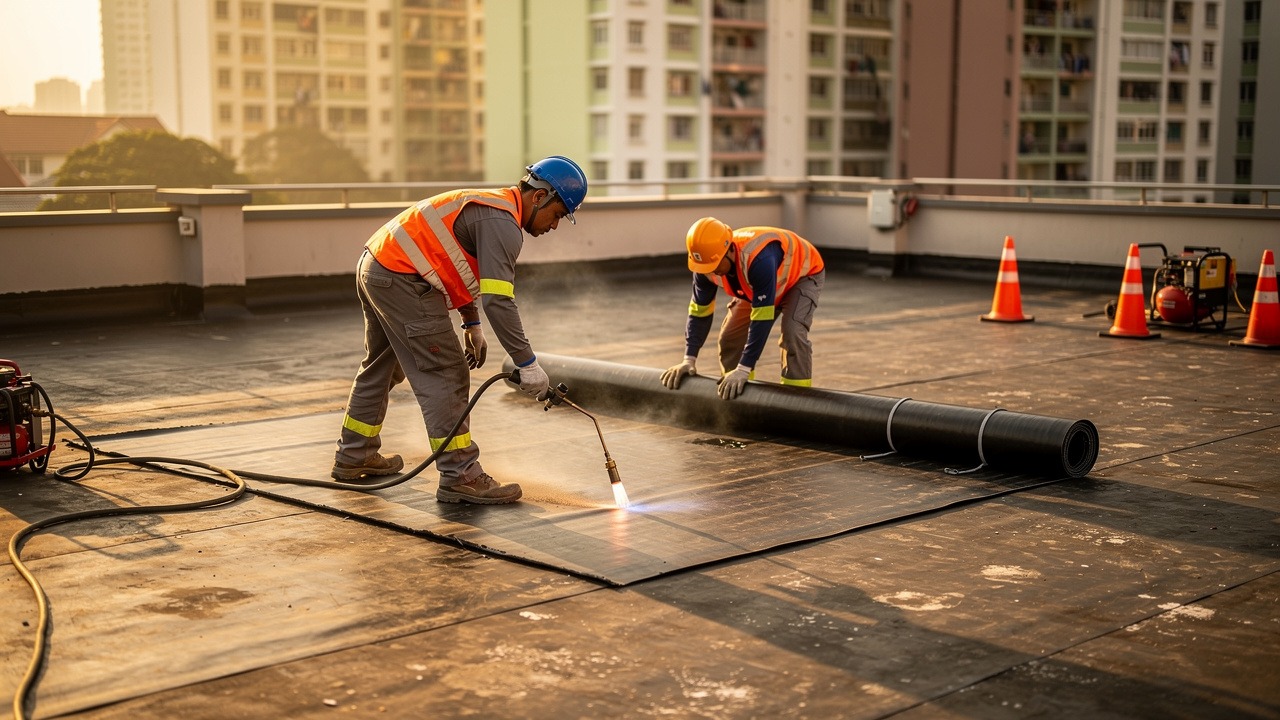
Allstar works on metal, tiled and reinforced-concrete roofs and provides roof repair together with waterproofing systems for suitable projects.
The visible ceiling stain may not sit directly below the roof defect because water can travel along structural elements before entering the room.
That is why a top-floor leak that appears only during rain should trigger a roof and building-envelope investigation rather than immediate sealing of the ceiling itself.
Could a Pipe Be Leaking Above the Ceiling?
Yes.
Concealed pipes, sanitary fittings, appliance connections and other plumbing components can create ceiling leakage.
A plumbing source becomes more likely when moisture continues regardless of rainfall or wet-area surface use.
PUB advises property owners to look for signs such as unexplained increases in water use, sounds of running water when fixtures are not in use and continued water-meter movement after water-using appliances and taps have been turned off.
If a plumbing defect is confirmed, the actual pipe or fitting needs to be repaired.
Applying waterproofing to the ceiling below does not repair a leaking water pipe.
Should You Call a Plumber or a Waterproofing Contractor?
The correct trade depends on what has failed.
A plumber is generally appropriate when the leak originates from a water pipe, sanitary fitting, toilet connection or another plumbing component.
A waterproofing or leakage-repair specialist is more appropriate when the water is entering through a wet-area membrane, concrete slab, roof, balcony, external wall, joint or another part of the building envelope.
If the source is uncertain, diagnose the problem before choosing the repair trade.
Calling a plumber simply because the ceiling stain is below a bathroom can waste time if the actual defect is waterproofing.
Likewise, coating the ceiling or wall will not solve a leaking pipe.
The trade should follow the defect.
How Do Professionals Find the Source of Ceiling Leakage?
A good ceiling-leak investigation begins with the building layout and the history of the problem.
The contractor should ask what lies above the affected ceiling, when the moisture appears, whether it follows rainfall or water use and whether previous repair work has already been attempted.
The visible stain is then compared with possible water routes.
For harder-to-trace cases, specialist tools can provide additional evidence.
Allstar’s published guidance discusses thermal imaging, moisture measurement and acoustic or ultrasonic methods for appropriate concealed-leak investigations.
Thermal imaging can reveal temperature patterns associated with moisture.
Moisture meters can compare affected and drier areas.
Acoustic tools can help narrow down selected pressurised plumbing leaks.
These tools are useful primarily for narrowing the investigation. They do not necessarily identify the exact physical defect by themselves.
Their findings still need to be interpreted together with the property layout and the conditions under which the leak occurs.
How Is a Ceiling Leak Repaired?
The repair method depends on the source.
A concrete crack, failed bathroom waterproofing system, roof defect and leaking plumbing pipe should not be treated in the same way.
A practical repair framework looks like this:
| Confirmed or likely defect | Typical repair direction |
| Plumbing pipe or fitting | Plumbing repair |
| Localised concrete crack or joint | PU injection may be appropriate |
| Failed bathroom waterproofing | Wet-area waterproofing repair |
| Extensive membrane or screed deterioration | Hacking and reinstatement may be required |
| Roof component defect | Roof repair plus waterproofing where appropriate |
| External-wall crack or failed joint | Crack/joint repair and suitable exterior treatment |
| Spalling or deteriorated concrete | Concrete repair plus correction of the moisture source |
The purpose of inspection is to move from “my ceiling is wet” to “this specific component has failed and this specific repair addresses it.”
When Is PU Injection Used for Ceiling Leakage?
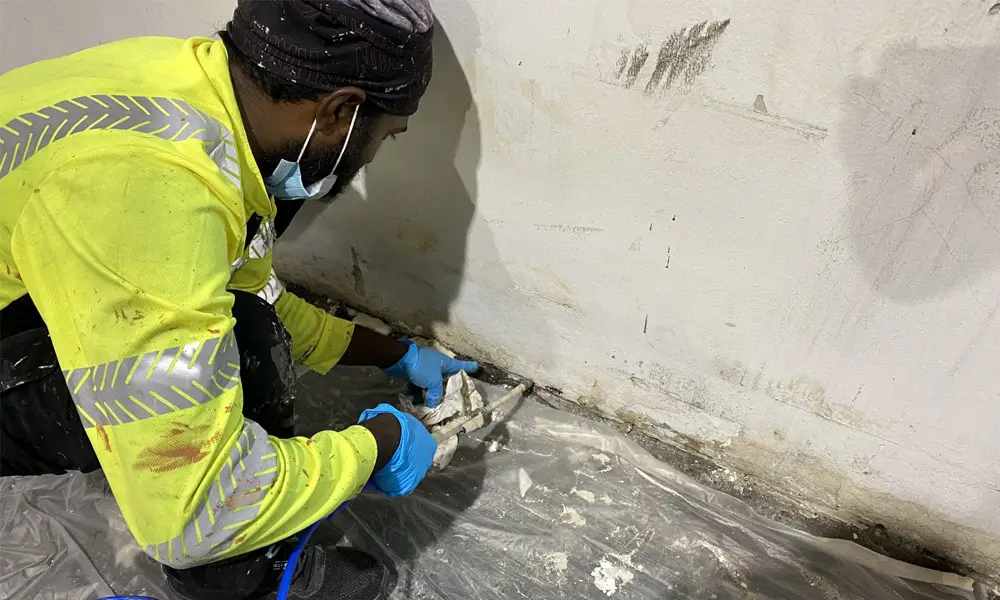
Polyurethane injection, often called PU injection or PU grouting, can be used where water is travelling through suitable concrete cracks, joints, voids or honeycombed areas.
Allstar describes PU injection as forcing polyurethane material under pressure into the affected concrete.
When the material contacts moisture, it reacts and expands, helping to seal the pores or cracks through which water is moving.
This can be useful where the identified water pathway lies within an appropriate concrete defect.
PU injection is not a universal repair for every ceiling leak.
If the real problem is a failed bathroom membrane, roof defect or plumbing pipe, that system still needs to be addressed.
Before accepting injection work, ask:
What water pathway is being injected, and why is PU suitable for that defect?
Can a Ceiling Leak Be Repaired From Below?
Sometimes.
Where water is passing through a suitable concrete crack or joint, injection from the underside of the slab may be technically appropriate.
This can allow certain localised leaks to be treated without opening a much larger area above.
However, treating the underside is not automatically a permanent repair for every ceiling leak.
If the original source is an extensively failed bathroom waterproofing system, defective drainage, a pipe leak or damaged roof component, repairing only the lower ceiling may leave the source untouched.
A repair from below should therefore be viewed as one method for appropriate concrete pathways, not as a universal shortcut for avoiding work above.
Can Ceiling Leakage Be Repaired Without Hacking?
Yes, in suitable situations.
PU injection, crystallisation-based treatments such as Flood Infusion and selected non-hacking waterproofing approaches can reduce demolition when the defect and substrate are appropriate.
HDB’s current guidance recognises several possible methods for inter-floor leakage, including re-screeding and waterproofing, localised repair, chemical grout or PU injection and other alternative waterproofing approaches depending on the condition and severity of the leak.
However, “no hacking” is not automatically better.
Loose tiles, badly deteriorated screed, extensive membrane failure, drainage problems or damaged substrate may require the affected area to be opened so the failed layers can be repaired or replaced.
The useful question is not:
“Can I avoid hacking?”
It is:
“Can this particular ceiling leak be repaired properly without hacking?”
Who Pays for Ceiling Leakage Between HDB Flats?
For an inter-floor ceiling leak in an HDB block, the upper-floor owner is not automatically responsible for the entire repair bill.
HDB states that flat owners are responsible for maintaining their respective flats, including the shared floor and ceiling slabs.
Where those slabs need repair to resolve the leakage, the upper- and lower-floor owners should arrange the repair together and split the costs involved.
HDB advises the lower-floor owner to approach the upper-floor neighbour, discuss the possible cause and decide whether a contractor should be jointly engaged.
The situation changes when the source is common property.
For a top-floor flat where leakage originates from the block roof, HDB states that the roof is common property maintained by the Town Council.
The first question should therefore be:
Where is the leak actually coming from?
Only after the source is known can repair responsibility be assessed properly.
Who Is Responsible for Ceiling Leakage in a Condominium?
For strata-titled condominiums, Singapore’s strata framework provides an important starting presumption.
BCA states that where water seepage is visible on the interior ceiling of a strata unit, the defect is presumed to be located in the unit immediately above unless evidence shows otherwise.
That presumption does not mean the upper-floor owner should automatically approve a repair without investigation.
BCA says that the upper- and lower-floor subsidiary proprietors should jointly investigate the cause.
They should then determine the required repair and their respective share of the repair costs based on the findings.
Where the actual source is common property, responsibility changes.
A roof, façade or shared building component maintained as common property may instead require involvement from the Management Corporation.
For a condo ceiling leak, the practical sequence is therefore:
document the leakage → notify the relevant neighbour or managing agent → investigate jointly → identify the source → determine the repair and responsibility based on the evidence.
How Much Does Ceiling Leakage Repair Cost in Singapore?
There is no single ceiling-leak repair price because the ceiling stain is a symptom rather than a standard scope of work.
A plumbing repair, local PU injection, bathroom waterproofing project, roof repair and concrete repair all involve different materials, labour, access and reinstatement.
Allstar currently publishes approximately S800toS1,500 as a planning reference for waterproofing an average bathroom of around four to six square metres.
This should be treated as a bathroom-waterproofing planning reference, not a universal ceiling-leak price.
Allstar also publishes approximately S5toS20 per square metre as an indicative starting reference for certain roof-waterproofing applications.
Again, that figure is roof-specific and should not be applied to bathroom repair, PU injection, plumbing or concrete work generally.
Projects involving hacking, screed replacement, tile reinstatement, extensive substrate repair or difficult exterior access can have very different costs.
A site-specific quotation after diagnosis is therefore more useful than trying to assign every wet ceiling the same price.
What Should a Ceiling Leakage Repair Quotation Include?
A useful quotation should make the repair logic understandable.
It should identify the suspected source and the treatment area.
The proposed repair method should be stated clearly enough for the owner to understand why it is suitable.
If hacking is required, the quotation should explain whether tile removal, screed work and reinstatement are included.
If PU injection is proposed, it should be clear which crack, joint or concrete pathway is being treated.
Where roof, façade or specialist-access work is involved, those requirements should also be defined.
The quotation should address the expected stages or visits where relevant, along with curing and reinstatement.
It should also explain whether post-repair testing or verification forms part of the scope.
Finally, warranty terms should identify the covered repair area, duration and important exclusions.
A quotation that simply states “waterproofing works” without explaining the defect and repair scope is difficult to compare meaningfully with another proposal.
How Long Does Ceiling Leakage Repair Take?
The duration depends on the actual cause.
A small localised injection or simple repair may take much less time than rebuilding a failed bathroom waterproofing system or carrying out roof and concrete work.
Hacking, surface preparation, curing, reinstatement, access and weather can all affect the programme.
The application itself is also not the entire project.
After the source is repaired, the affected ceiling may need time to dry before final cosmetic reinstatement.
Repainting too early can trap moisture or allow staining to reappear through the new finish.
How Do You Know Whether the Ceiling Leak Has Been Fixed?
A dry-looking ceiling immediately after repair is not enough to prove that the leak has stopped.
The repair should be verified against the same condition that originally triggered the leakage.
If the ceiling leaked during heavy rain, the repaired area should remain dry during subsequent comparable rainfall after the repair has properly cured.
If the leak appeared after showering or bathroom use, the area should remain dry during normal use or an appropriate water test where suitable.
If the problem was a plumbing leak, there should no longer be unexplained water flow after the pipe or fitting has been repaired.
The key question is:
Does new water still enter when the condition that previously caused the leak occurs?
Only after that has been established should final ceiling repainting or other cosmetic reinstatement be treated as complete.
What Should You Do if the Ceiling Stain Returns?
Photograph the area before repainting it.
Record whether the stain returned in exactly the same location and whether the same trigger was involved.
If a rain-related ceiling stain returns during comparable rainfall, the original water pathway may still be active.
If moisture appears somewhere different or under different circumstances, a separate defect may have developed.
Review the original quotation, photographs, invoice, repair scope and warranty before asking the contractor to reassess the area.
This makes it easier to distinguish between failure or recurrence of the repaired defect and a new leak from another source.
How Do You Choose a Ceiling Leakage Repair Contractor?
Start with the diagnosis rather than the cheapest price.
A useful contractor should be able to answer four questions:
What do you believe is causing the ceiling leak?
What evidence supports that diagnosis?
Why is this repair appropriate?
How will we know whether the repair worked?
The quotation should identify the treatment area, method, preparation, hacking where relevant, reinstatement, expected timeline and warranty.
Allstar states that it provides comprehensive inspections and has more than 20 years of industry experience. Its current repair guidance also states that repair work is backed by a one-year warranty, with extended options available for discussion.
The exact repair area, warranty duration, exclusions and claim process should still be confirmed in writing for the individual project.
Credentials are useful supporting information, but they should not replace a clear technical explanation of the actual leak.
How Can You Reduce the Risk of Another Ceiling Leak?
Prevention depends on the original source.
For bathrooms and other wet areas, investigate recurring dampness, loose finishes, deteriorated joints or moisture appearing outside the normal wet zone before major ceiling damage develops below.
For roofs, keep drainage clear and investigate ponding, damaged tiles, deteriorated flashing, failed joints or visible membrane damage.
External-wall cracks and ageing joints should be investigated when interior moisture repeatedly appears after rain.
Plumbing defects should be repaired at the pipe or fitting rather than repeatedly sealing the surrounding ceiling.
After any repair, retain photographs, the quotation, invoice, work scope and warranty.
If moisture returns later, those records make it much easier to compare the new symptom with the original defect.
Frequently Asked Questions About Ceiling Water Leakage in Singapore
What Should I Do First if Water Is Dripping From My Ceiling?
Move people, valuables and electronics away from the area. Contain dripping water where safe and isolate a clearly identified plumbing supply if you can do so safely. Avoid touching wet electrical fittings or standing under a visibly sagging ceiling. Photograph the leak and note whether it follows rain, bathroom use or another trigger before arranging an inspection.
Is a Leaking Ceiling Dangerous?
It can be. Active water near electricity, significant sagging or bulging, falling material, rapidly increasing leakage and spalling concrete deserve prompt attention. A small stable stain may not present the same immediate risk, but recurring moisture should still be investigated before the damage progresses.
Should I Call a Plumber or Waterproofing Contractor?
Use a plumber where the confirmed defect involves a pipe, fitting or plumbing system. A waterproofing or leakage-repair specialist is more appropriate for failed bathroom membranes, concrete slabs, roofs, façades and other building-envelope defects. If the source is uncertain, investigate before approving the repair.
Can a Ceiling Leak Be Repaired From Below?
Sometimes. PU injection from below may be appropriate for selected concrete cracks or joints. It is not automatically suitable where the original source is a failed bathroom waterproofing system, roof defect or plumbing pipe above.
Can Ceiling Leakage Be Repaired Without Hacking?
Yes, in suitable cases. PU injection, crystallisation-based treatment and other non-hacking approaches can reduce demolition when the water pathway and substrate are appropriate. Extensive membrane, screed, drainage or substrate failure may still require hacking and reinstatement.
Who Pays for Ceiling Leakage Between HDB Flats?
HDB states that when repair to the shared floor and ceiling slab is required, the upper- and lower-floor owners should arrange the work together and split the costs involved. If the leakage originates from common property such as the roof above a top-floor flat, the Town Council should be contacted.
Who Is Responsible for a Condo Ceiling Leak?
BCA states that interior ceiling seepage is presumed to originate from the unit immediately above unless evidence shows otherwise. The upper- and lower-floor owners should jointly investigate and determine the repair and their respective repair-cost shares based on the findings.
How Much Does Ceiling Leakage Repair Cost in Singapore?
There is no universal price because the source determines the work required. Allstar publishes approximately S800toS1,500 as a planning reference for waterproofing an average four-to-six-square-metre bathroom. Roof, plumbing, PU injection, concrete repair and projects requiring hacking or extensive reinstatement have different scopes and should be assessed separately.
What Should a Ceiling Leakage Repair Quotation Include?
It should explain the suspected source, repair area, proposed method, preparation, hacking where relevant, reinstatement, expected timeline, verification and warranty. Quotations should be compared only after confirming that the contractors are proposing comparable repair scopes.
How Do I Know Whether the Ceiling Leak Is Fixed?
Test the repair against the original trigger after the system has properly cured. Rain-related leakage should remain dry during comparable rainfall, bathroom-related leakage should not recur during normal use or appropriate testing, and plumbing leakage should no longer produce unexplained water flow.
Does Allstar Provide a Warranty for Ceiling Leakage Repair?
Allstar currently states that its repair work is backed by a one-year warranty, with extended warranty options available for discussion. The exact treated area, duration, exclusions and claim process should be confirmed in the written quotation for the specific job.
Conclusion
Ceiling water leakage in Singapore should be treated as a source problem before it becomes a ceiling-repair problem.
The visible stain or drip may originate from a bathroom above, concealed plumbing, a roof defect, concrete crack, balcony or exterior building element.
Because water can travel before it becomes visible, repairing or repainting the nearest damaged ceiling surface may leave the real defect untouched.
The practical sequence is:
make the area safe → document when the leak occurs → identify the source → choose a repair that matches the defect → verify the result → allow the ceiling to dry → reinstate the finish → monitor for recurrence.
For HDB and condominium properties, finding the source also helps determine which neighbour, Town Council, MCST or owner should be involved.
Allstar Waterproofing & Services provides ceiling leakage repair together with wet-area waterproofing, water seepage repair, roof waterproofing and repair, concrete repair and difficult-access exterior work.
The best ceiling-leak repair is therefore not automatically the one involving the least hacking or the fastest cosmetic result.
It is the one that can clearly answer:
Where is the water coming from? What has failed? Why is this repair suitable? How will we confirm that the leak has stopped?