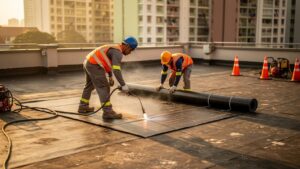
Water leakage repair in Singapore works best when the source is identified before the visible damage is patched.
A brown ceiling stain, damp wall or peeling surface may be where water finally appears, but the actual entry point can be somewhere else entirely. Water can travel through screed, concrete slabs, roof joints, cracks, wet-area membranes, pipes and concealed cavities before becoming visible inside a room.
That is why an effective repair should follow this sequence:
identify the source → match the repair to the defect → complete the necessary work → verify that the water has stopped → reinstate damaged finishes → monitor for recurrence.
Common causes in Singapore include failed bathroom waterproofing, roof defects, concrete cracks, external-wall water ingress and plumbing leaks.
Allstar Waterproofing & Services provides water leakage and seepage repair together with wet-area waterproofing, roof waterproofing and repair, concrete repair and difficult-access exterior work for residential, commercial and industrial properties. Its published process begins with inspection so the repair method can be matched to the defect rather than chosen simply from the location of the stain.
This guide explains what to do when leakage appears, which repair method may suit different problems, when hacking may be necessary, what repairs may cost, what HDB and condominium owners should know and how to determine whether the repair actually worked.
What Should You Do Immediately When You Discover Water Leakage?
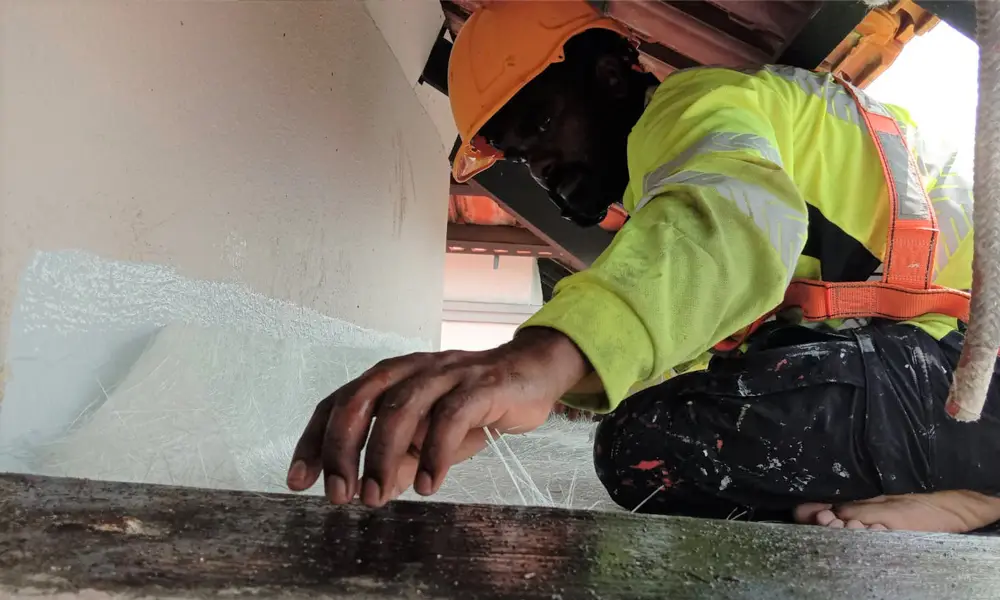
The first priority is to limit further damage without destroying evidence that may help identify the source.
If a tap, fitting or plumbing pipe is actively leaking and the relevant water supply can be safely isolated, shutting off the supply can reduce additional water escape.
Move furniture, electronics and other vulnerable belongings away from the affected area where practical.
If water is close to electrical switches, sockets, light fittings or exposed wiring, avoid touching the wet area or electrical equipment and arrange appropriate professional assistance.
For rain-related, ceiling or wet-area leakage, photograph the dampness before repainting or sealing anything. Record whether the leak appears during heavy rain, after showering, when a toilet is used or under some other repeatable condition.
Do not treat repainting as the repair.
The immediate goal is to control active water where possible, document the symptom and identify what needs to be repaired.
Which Water Leakage Repair Method Fits Which Problem?
Different defects require different repairs.
| Suspected problem | Typical repair direction |
| Leaking pipe, fitting or sanitary system | Plumbing repair |
| Localised concrete crack, joint or honeycombed area | PU injection may be suitable |
| Failed bathroom or wet-area waterproofing | Wet-area waterproofing repair |
| Extensive membrane, screed or substrate failure | Hacking and reinstatement may be necessary |
| Defective roof component | Roof repair followed by suitable waterproofing where required |
| External-wall crack or failed joint | Crack/joint repair and appropriate exterior treatment |
| Localised concrete deterioration or spalling | Concrete repair plus correction of the water source |
| Suitable porous concrete or wet-area seepage | Crystallisation-based treatment may be considered |
This is a diagnostic guide, not a substitute for inspection.
A ceiling stain below a bathroom does not prove that the waterproof membrane has failed. A pipe could be leaking.
Likewise, applying PU injection simply because water appears through concrete will not solve a roof defect or plumbing problem above.
The correct repair is the one that addresses what actually failed.
What Causes Water Leakage in Singapore Properties?
Water leakage occurs when plumbing water, wet-area water or rainwater escapes its intended route and finds another path through the building.
Bathrooms and toilets are common sources because water is repeatedly used above waterproofing systems concealed beneath tiles and screed.
Roof leakage can develop through deteriorated flashing, cracked tiles, open joints, loose fasteners, corrosion, membrane damage or areas where water ponds.
External walls can admit rainwater through cracks, ageing joints, failed interfaces or porous surfaces.
Concrete cracks, construction joints and honeycombed areas can create additional pathways.
Plumbing defects form a separate category. A damaged pipe, fitting or toilet cistern can create a damp ceiling or wall that looks very similar to a waterproofing problem.
For this reason, similar-looking water stains can require completely different repairs.
Should You Call a Plumber or a Waterproofing Contractor?
The trade should follow the defect.
If the leak is coming from a water pipe, sanitary fitting, toilet cistern or regulated plumbing system, a plumber is generally the appropriate specialist.
PUB advises property owners to engage a Licensed Plumber to detect and repair plumbing leaks. It also recommends checking for signs such as unexplained increases in water bills, water-running sounds and continuing water-meter movement when taps and water-using appliances are turned off.
A waterproofing or water-leakage specialist is more appropriate when the problem involves a failed bathroom membrane, concrete slab, roof, balcony, façade, structural joint or another building-envelope defect.
If the source is unclear, diagnosis should come before approving the repair.
Calling a plumber simply because the stain is near a bathroom can waste time if the actual defect is waterproofing.
Calling a waterproofing contractor to coat a wall will not repair a leaking pipe.
How Is the Correct Repair Method Chosen?
The repair should begin with evidence rather than a preferred product.
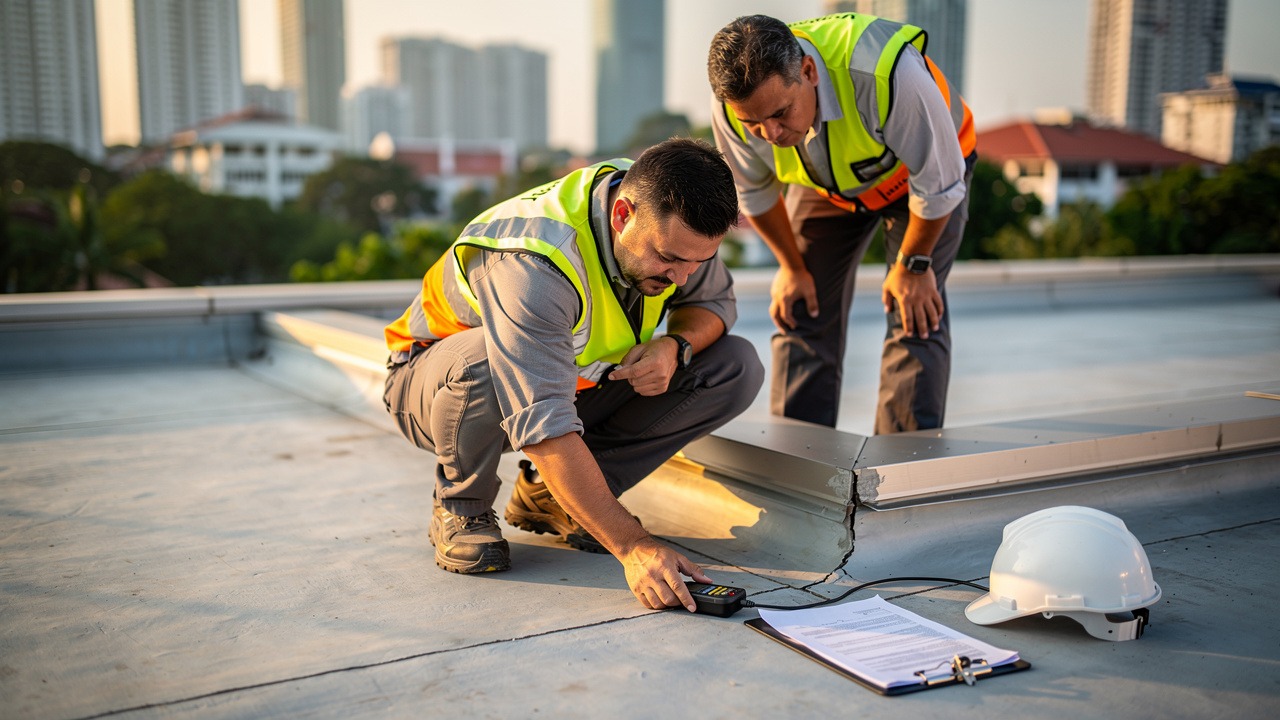
A contractor should look at when the leakage occurs, what building element sits above or behind the affected area, whether the problem changes with rainfall or water use and whether previous waterproofing or repair work has been carried out.
For complicated hidden leaks, moisture measurement, thermal imaging or acoustic investigation may provide additional evidence.
These tools are primarily useful for narrowing the search area. They do not automatically identify the exact physical defect by themselves.
Once the source and likely water path are understood, the repair can be selected according to the failed component.
That is a much stronger basis for repair than choosing PU injection, coating or hacking simply because it is the contractor’s preferred method.
Can Water Leakage Be Repaired Without Hacking?
Yes, some water leakage repairs can be repaired with little or no hacking.
However, avoiding hacking should not become the objective before the condition has been inspected.
PU injection can be useful for suitable localised concrete cracks and joints.
Crystallisation-based treatment may be appropriate in selected concrete or wet-area seepage situations.
Other restorative waterproofing methods may also reduce demolition where the underlying substrate remains suitable.
HDB itself recognises alternatives including chemical grout or PU injection, Flood Infusion and other waterproofing approaches for appropriate inter-floor ceiling-leak cases.
However, loose tiles, badly deteriorated screed, drainage defects, extensive membrane failure or damaged substrate may require the area to be opened so the failed layers can be accessed and rebuilt.
The useful question is therefore not:
“Can I avoid hacking?”
It is:
“Can this particular leak be repaired properly without hacking?”
How Does PU Injection Repair Water Leakage?
Polyurethane injection, also called PU injection or PU grouting, is commonly used where water is travelling through suitable concrete cracks, joints, voids or honeycombed areas.
The polyurethane material is injected under pressure into the affected pathway.
When the appropriate material reacts with moisture, it expands and helps fill the spaces through which water is travelling.
This can make PU injection useful for selected localised leaks through concrete without opening a much larger surface.
However, PU injection is not a universal answer to ceiling leakage.
If water is entering because a bathroom waterproofing membrane has extensively failed, the waterproofing system itself may need repair.
If the source is a roof defect, the roof needs attention.
If a pipe is leaking, repairing the pipe remains necessary.
Before accepting injection work, ask:
What water pathway is being injected, and why is PU injection suitable for that defect?
Can a Ceiling Leak Be Repaired From Below?
Sometimes.
Where water is travelling through a suitable concrete crack or joint, injection from the underside of the slab may be technically appropriate.
That does not mean every ceiling leak can be permanently repaired from the lower unit.
If the original source is an extensively failed wet-area waterproofing system, defective drainage, a plumbing leak or a damaged roof, treating only the underside may leave the primary defect untouched.
Repairing from below should therefore be considered a method for suitable water pathways, not a universal shortcut for avoiding work above.
What Is Crystallisation-Based Waterproofing?
Allstar uses a crystallisation-based treatment known as Flood Infusion for suitable seepage situations.
The approach is intended to work within pores and capillaries in concrete, helping reduce water penetration without necessarily removing large areas of finished surface.
This can make a crystallisation approach useful in appropriate concrete or wet-area conditions where the existing substrate remains suitable.
It should not, however, be interpreted as a substitute for rebuilding extensively deteriorated layers.
Where screed, finishes, drainage or the underlying waterproofing system has failed significantly, a more invasive repair can still provide the more appropriate long-term solution.
When Does Bathroom Waterproofing Need to Be Repaired or Rebuilt?
Bathroom leakage can originate from several components, including waterproofing membranes, screed, joints, drainage interfaces and plumbing penetrations.
A cracked grout line is not automatically the root cause.
If the underlying waterproofing remains sound, a localised treatment may sometimes be sufficient.
If the membrane or screed has deteriorated extensively, removing tiles and rebuilding the waterproofing system may be necessary.
This is why the extent of hacking should be decided after the condition beneath the visible finish is understood.
A repair that creates less disruption is valuable only when it also addresses the defect properly.
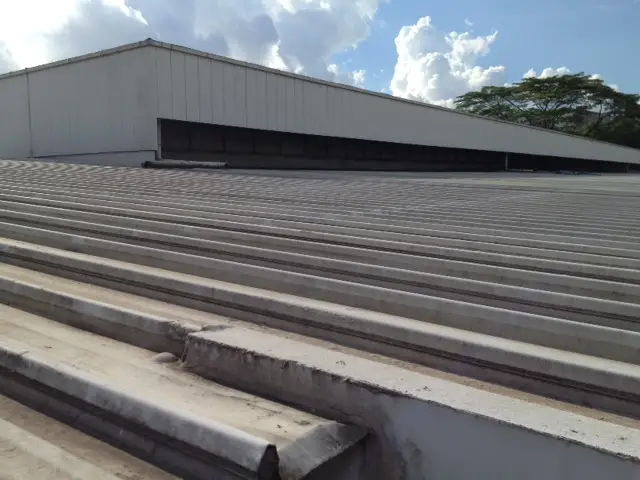
How Are Roof Leaks Repaired?
Roof repair should begin with the failed roof component.
Possible defects include deteriorated flashing, cracked or displaced tiles, open joints, loose fasteners, damaged membranes, oxidation and ponding water.
Simply coating the interior ceiling does not repair these defects.
The roof component should first be repaired or prepared appropriately, after which a suitable waterproofing system may be applied where necessary.
Allstar currently provides roof repair and waterproofing for metal, tiled and reinforced-concrete roofs and uses liquid-applied or other membrane systems according to project conditions.
The treatment should follow the roof construction and actual defect rather than assuming that one coating works for every roof.
How Are External-Wall Leaks Repaired?
External-wall leakage can involve cracks, failed joints, porous substrates or interfaces around windows and other façade elements.
A repair may involve sealing cracks or joints, correcting defective interfaces and applying a suitable protective treatment where required.
Again, the entry point matters.
Covering an interior wall with waterproofing paint will not necessarily stop rain entering through an exterior joint several metres away.
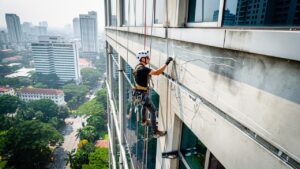
For high-rise or difficult-access façade areas, specialist access may also form part of the project.
Allstar provides rope-access work and states that its rope-access operations use IRATA-certified personnel.
How Much Does Water Leakage Repair Cost in Singapore?
There is no single reliable water-leakage-repair price because “water leakage Repair” is a symptom rather than one standard service.
A local PU injection repair, bathroom waterproofing project, roof repair, façade repair, plumbing job and concrete-restoration project have very different scopes.
Allstar currently publishes approximately S800toS1,500 as a planning reference for waterproofing an average bathroom of around four to six square metres. This should be understood as an Allstar bathroom-waterproofing planning reference, not a universal cost for every water leak.
A project requiring extensive hacking, new screed, tile reinstatement, drainage correction, damaged concrete repair or difficult access can cost substantially more.
Roof and façade projects are also heavily influenced by treatment area and access requirements.
A site-specific quotation therefore becomes more useful than trying to assign every ceiling stain one online price.
What Affects the Cost of Water Leakage Repair?
The defect itself is one of the largest cost factors.
A local concrete crack requires a different repair from a bathroom with widespread membrane and screed failure.
Treatment area matters too, although the size of the visible stain does not necessarily indicate how large the actual repair area will be.
Access can significantly influence roof and façade projects.
Preparation also matters. Loose materials may need removal, concrete may need repair and surfaces may need to be cleaned or prepared before waterproofing begins.
Hacking and reinstatement can increase the project scope substantially because the job no longer involves only stopping the water; damaged tiles, screed and finishes may also need rebuilding.
The final quotation should therefore reflect the source, treatment area, access, repair method, preparation and reinstatement required.
Why Can Two Water Leakage Repair Quotations Be Very Different?
Two contractors may both quote for “water leakage repair” while proposing completely different work.
One may plan to inject a local concrete crack.
Another may believe the problem originates from the bathroom above and include wet-area waterproofing.
Another may include hacking, new screed and tile reinstatement.
A roof quotation may include repair to flashing and membrane work, while another may quote only for a surface coating.
That means price should not be compared until the scopes are comparable.
A S400quotationandaS1,500 quotation are not necessarily competing solutions if they are attempting to repair different defects.
The useful comparison is:
same suspected defect → comparable repair objective → comparable scope → comparable reinstatement and verification → final price.
What Should a Water Leakage Repair Quotation Include?
A good quotation should make the repair understandable before work begins.
It should state what the contractor believes is causing the leakage and identify the area being treated.
The proposed repair method should be explained clearly enough that the owner can understand why it fits the suspected defect.
If hacking is required, the quotation should clarify whether removal and reinstatement of tiles, screed or finishes are included.
If specialist access, concrete repair or additional preparation is required, those items should also be identified.
The quotation should explain how many visits or stages are expected where relevant and whether post-repair testing or verification forms part of the scope.
Warranty terms should define the covered area, duration and important exclusions.
A quotation that simply says “waterproofing works” without describing the source, repair area and actual scope is difficult to compare meaningfully with another proposal.
How Long Does Water Leakage Repair Take?
Repair duration depends on what needs to be done.
A small local injection or sealant repair may sometimes be completed within a day.
Wet-area waterproofing, roof treatment, concrete repair and projects involving hacking and reinstatement can take several days or longer.
Preparation and curing matter as much as application time.
Exterior work can also be affected by weather.
The fastest treatment is therefore not automatically the fastest complete repair if further curing, testing or reinstatement is still required.
Who Pays for Ceiling Leakage Between HDB Flats?
For inter-floor ceiling leakage between HDB flats, the upper-floor owner is not automatically responsible for the entire repair bill.
HDB states that flat owners are responsible for maintaining their respective flats, including the shared floor and ceiling slab.
Where repair to that slab is required to resolve the leakage, the upper- and lower-floor owners should arrange the work together and split the costs involved.
HDB advises the lower-floor owner to approach the upper neighbour, discuss the possible cause and determine whether a contractor should be jointly engaged.
The situation changes when the leakage comes from common property.
For a top-floor flat where leakage originates from the block roof, HDB states that the roof forms part of common property maintained by the Town Council.
The first question is therefore:
Where is the water actually coming from?
Who Is Responsible for Water Leakage Between Condominium Units?
For strata-titled condominiums, Singapore’s strata-management framework provides a useful starting point.
BCA’s Strata Management Guide states that where water seepage is evident on the interior ceiling of a unit, the defect is presumed to be situated within the unit immediately above unless evidence shows otherwise.
This presumption does not eliminate the need for investigation.
BCA says that the upper- and lower-floor subsidiary proprietors should jointly investigate the cause of the seepage. The affected owners should then decide their respective share of the repair costs.
Where the source is common property, the responsibility can instead involve the Management Corporation.
The practical sequence is:
document the leakage → involve the relevant neighbour or managing agent → investigate the source → establish what needs to be repaired → determine responsibility and cost-sharing based on the findings.
For disputed or complicated cases, owners should refer to their MCST and the applicable strata-management process rather than relying solely on the location of the stain.
What About Landed Homes and Commercial Properties?
Landed homes can involve more leakage routes because the owner is responsible for the roof, balconies, exterior walls, drainage and other external building elements.
A ceiling stain after rain may therefore require inspection of several roof or façade areas before the actual entry point is identified.
Commercial and industrial buildings can involve larger roofs, reinforced-concrete structures, service areas and operating constraints.
Access can also become a major part of the scope where façade or roof defects occur at height.
This is why a residential bathroom-waterproofing price should not be used as a benchmark for large commercial leakage repair.
How Do You Know Whether Water Leakage Repair Worked?
A successful repair should be verified against the same conditions that previously triggered the leakage.
If the ceiling leaked during heavy rain, the repaired area should remain dry through subsequent comparable rainfall after the repair system has properly cured.
If the leakage was associated with showering or bathroom use, the area should remain dry during normal use or an appropriate water test where suitable.
If a plumbing leak was repaired, there should no longer be unexplained water flow. PUB recommends turning off taps and water-using appliances and checking the water meter; continued movement indicates that leakage may still be present.
Do not judge the repair solely because the ceiling looks dry immediately after treatment.
Concrete, screed and finishes can retain moisture and take time to dry.
The more meaningful question is:
Does new water still enter when the condition that previously caused the leak occurs?
Verification should come before final cosmetic reinstatement where practical.
What Should You Do If the Leak Returns?
Document the new leakage before repainting.
Photograph where it appears and record whether it returned under the same conditions as before.
A rain-related leak that returns during similar rainfall may indicate that the original pathway remains active.
Moisture appearing in a different location or under different conditions may indicate a separate defect.
Review the original quotation, invoice, photographs, repair scope and warranty before asking the contractor to reassess the area.
Those records make it easier to distinguish between recurrence of the repaired defect and a new water pathway.
How Do You Choose a Water Leakage Repair Contractor?
Start with the diagnosis rather than the cheapest price or most attractive repair method.
A contractor should be able to explain:
What do you believe has failed?
What evidence supports that conclusion?
Why is this repair suitable for that defect?
How will we know whether the repair worked?
Allstar’s current repair guidance similarly emphasises matching the method to the defect and comparing quotations according to diagnosis and scope rather than price alone.
Allstar states that it has more than 20 years of waterproofing experience and has served more than 3,000 residential, commercial and industrial properties. Its service pages also promote comprehensive inspections and a one-year repair warranty.
These company credentials can support the decision, but they should not replace a technically understandable proposal for the individual leak.
How Can You Reduce the Risk of Water Leakage Returning?
Prevention depends on maintaining the parts of the property that repeatedly encounter water.
Bathrooms and balconies should be investigated when persistent dampness, loose finishes, failed joints or moisture outside normal wet areas begins to appear.
Roof drainage should remain clear so water does not pond unnecessarily.
Damaged flashing, cracked tiles, deteriorated joints and defects in roof waterproofing should be investigated before repeated rainfall increases the damage.
External-wall cracks and ageing joints deserve attention when interior dampness repeatedly follows heavy rain.
Plumbing leaks should also be repaired promptly. PUB warns that prolonged leaks waste water, increase water bills and can cause property damage.
After a repair, retain the photographs, quotation, invoice, scope and warranty.
A good repair record makes future investigation much easier if moisture appears again.
Frequently Asked Questions About Water Leakage Repair in Singapore
How Much Does Water Leakage Repair Cost in Singapore?
There is no universal fixed price because the cost depends on the defect, repair area, method, access, preparation and reinstatement. Allstar publishes approximately S800toS1,500 as an indicative planning reference for waterproofing an average four-to-six-square-metre bathroom, but this should not be treated as the price for every leakage repair.
Should I Call a Plumber or Waterproofing Contractor for a Ceiling Leak?
Use a Licensed Plumber when the confirmed defect involves pipes, sanitary fittings or regulated plumbing systems. Waterproofing or leakage-repair specialists are more appropriate for membranes, concrete slabs, roofs, façades and building-envelope water ingress. If the source is uncertain, diagnose it before approving a repair.
Is Waterproofing the Same as Water Leakage Repair?
No. Water leakage repair addresses the defect that is allowing water to escape or enter. Waterproofing is one possible repair when the failed component is a waterproofing system. Other leakage cases may require PU injection, roof repair, joint repair, concrete work or plumbing.
Can Water Leakage Be Repaired Without Hacking?
Yes, in suitable cases. PU injection, crystallisation-based treatment and selected non-hacking wet-area approaches may reduce demolition where the substrate and water pathway are suitable. Extensive membrane, screed, drainage or substrate failure may still require hacking and reinstatement.
Can a Ceiling Leak Be Repaired From Below?
Sometimes. Injection from below can be suitable for selected concrete cracks or joints. If the original source is a failed wet-area membrane, plumbing pipe or roof component, treating only the lower ceiling may leave the actual defect unresolved.
Who Pays for an HDB Ceiling Leak?
Where repair to the shared floor and ceiling slab is necessary, HDB says the upper- and lower-floor owners should arrange the work together and split the costs involved. If the source is common property, such as the block roof above a top-floor unit, the Town Council is responsible for maintaining that common property.
Who Is Responsible for Condo Ceiling Leakage?
BCA states that interior ceiling seepage in a strata development is presumed to originate from the unit immediately above unless evidence shows otherwise. The upper and lower owners should jointly investigate and determine their respective repair-cost shares based on the findings.
What Should a Water Leakage Repair Quotation Include?
The quotation should explain the suspected source, treatment area, proposed method, preparation, hacking where relevant, reinstatement, access requirements, verification and warranty. Compare quotations only after confirming that the contractors are proposing comparable repairs.
How Long Does Water Leakage Repair Take?
A small injection or localised repair may sometimes be completed within a day, while wet-area waterproofing, roof treatment, concrete repair and work involving hacking and reinstatement can take several days or longer. Preparation, curing, weather and access all influence the schedule.
How Do I Know Whether the Repair Worked?
Test the result against the original trigger after the repair has properly cured. Rain-related leakage should not recur under comparable rainfall, wet-area leakage should remain dry during normal use or appropriate testing, and plumbing leakage should no longer produce unexplained water flow.
Does Allstar Provide a Warranty for Water Leakage Repair?
Allstar currently states that its repair work is backed by a one-year warranty, with extended warranty options available for discussion. The exact treated area, duration, exclusions and claim process should be confirmed in writing for the individual project.
Conclusion
Water leakage repair in Singapore is most effective when the repair method follows the defect rather than the visible stain.
A damp ceiling or wall can originate from bathroom waterproofing, a plumbing pipe, concrete crack, roof component, external joint or another water pathway.
That means PU injection, hacking, coatings and waterproofing should not be selected before the source is understood.
The practical sequence is:
control active water where safe → identify the source → match the repair to the defect → confirm the scope and price → complete the repair → verify the result → monitor for recurrence.
For HDB and condominium properties, determining the source also helps establish which neighbour, Town Council, MCST or owner needs to be involved.
Allstar Waterproofing & Services provides water leakage and seepage repair together with wet-area waterproofing, roof repair and waterproofing, concrete repair and specialist exterior-access work.
The best water leakage repair is therefore not automatically the one involving the least hacking, the lowest price or the most advanced product.
It is the repair that can answer four questions clearly:
What has failed? Why is this repair suitable? What exactly is included? How will we confirm that the water has stopped?